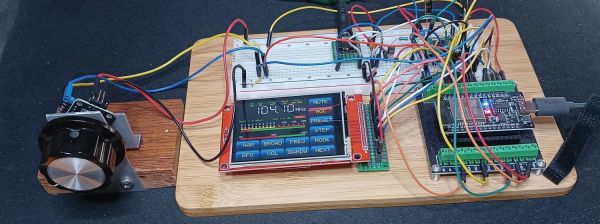
I've been building up a small collection of LCD screens for use with Arduino projects. I've uploaded a few example sketches mostly using Bodmer's TFT_eSPI library. I found it a little challenging to set the display configuration in the library, but otherwise it worked well. There seems to be some concern that the library is... Continue Reading →
Replacing a Rotary Encoder with a Magnetic Sensor and Potentiometer
I've been thinking if there is an easy way to make a simple and cheap control knob to replace those cheap quadrature rotary encoders in Arduino projects without the need to change the Arduino code or at least very minimal changes. This would only work if the angle sensor could produce a quadrature output like... Continue Reading →
Converting a Potentiometer For Use With a Magnetic Rotary Encoder
I've been experimenting with angle sensor modules to use them as a replacement for those cheap rotary encoders. I like those cheap rotary encoders, but I'm looking for something better where the knob turns smoothly and it doesn't wear out. The cheap encoders wear fairly quickly and then contact bounce can become a problem. Also,... Continue Reading →
Hot and Bothered: DHT22 Temperature Sensor Issues
When I was contemplating building a weather station, the part that I thought would be the most straightforward was measuring temperature. As reality often doesn't match expectations, this has not been the case. I am using a couple of DHT22 temperature and humidity sensors. One for indoor and another for outdoors. I found this Random... Continue Reading →
Building an Anemometer using a Bicycle Hub
In a previous post I looked at an anemometer that I bought from AliExpress that was built around a cheap toy motor. I wasn't happy with it so decided to salvage the cups from it for use in a scratch built one using a bicycle hub. It's been an interesting project and had more challenges... Continue Reading →
Inside a Cheap Aluminium Anemometer
Choosing an Anemometer I've been considering what to use for an anemometer for my weather station. I was thinking of making my own, but a significant downside would be calibrating it. I checked what was available on AliExpress. Many are plastic and I don't want a plastic one and I don't want to have to... Continue Reading →
Converting raw data samples into meaningful results: Calibration and formula generation
So you have a sensor connected to your microcontroller. How do you calibrate it, particularly if the values from the sensor are not linear? That's a problem I have thought about before and it came up again yesterday when I wanted a project to monitor a battery voltage level. The current project that I am... Continue Reading →
Chroma-chime: A kit using the first commercially available microcontroller
This week I learned that 40 years ago I built my first microcontroller project used the first commercially available microcontroller and didn't realise either of those things until now. It all began for me around 1981/82 when I built an electronic musical doorbell kit for my sister. It has been in use in two different... Continue Reading →
Reliably debouncing rotary encoders with Arduino and ESP32
I love those simple cheap rotary encoders as used in the KY-040 modules as a method of getting user input with Arduino and ESP32 projects. The issue of bounce with them is significant and for years I’ve been looking a reliable method of dealing with it. I thought I had it figured out by either... Continue Reading →