Water is precious in Australia. Much of Australia is very dry and regularly has droughts. From 2017 to 2019 we had a particularly nasty drought. Where we live, the long-term average rainfall is about 763 mm. 2017 and 2018 had lower rainfall and then in 2019 it dropped to only 314 mm. Everything dried out. Trees died in large numbers, and then the bushfires started. It became known as the Black Summer and was one of the most intense and catastrophic fire seasons on record in Australia. According to Wikipedia 24 million hectares (59 million acres; 240,000 square kilometres; 93,000 square miles) were burnt.
Armidale’s water supply got very low and the town of Guyra to the north ran out completely and had to have water trucked in.
Mains water is not available where we live, so we rely on rainfall and tanks to supply our house. We also have a small bore but it only supplies a modest amount of water. At most it will supply the toilet, a vegetable garden and occasional watering of shrubs when they become desperate. When drought hits, the vege garden has to be left to die.
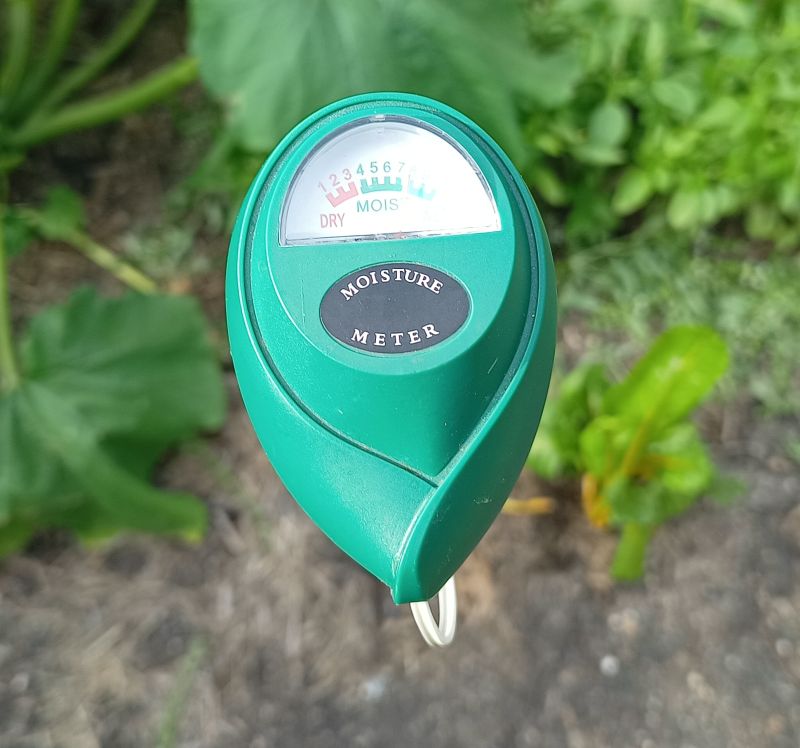
To try and make the best use of our available water, I decided to give a soil moisture meter a go. I bought a cheap one from AliExpress.
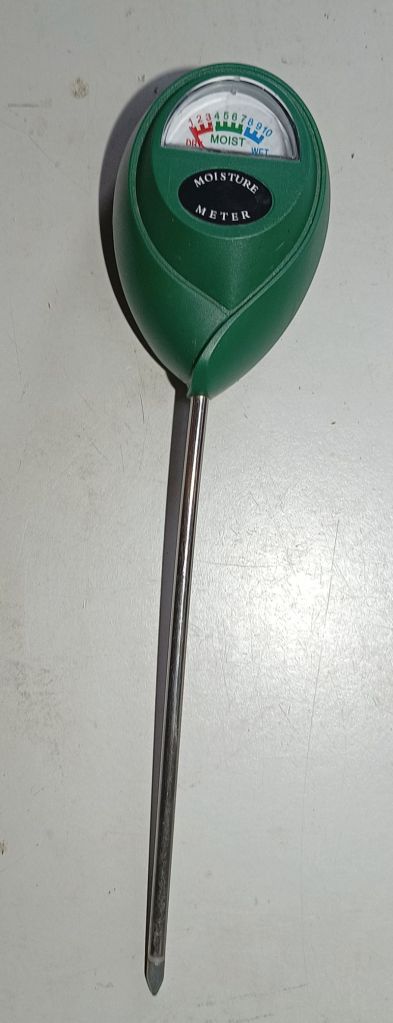
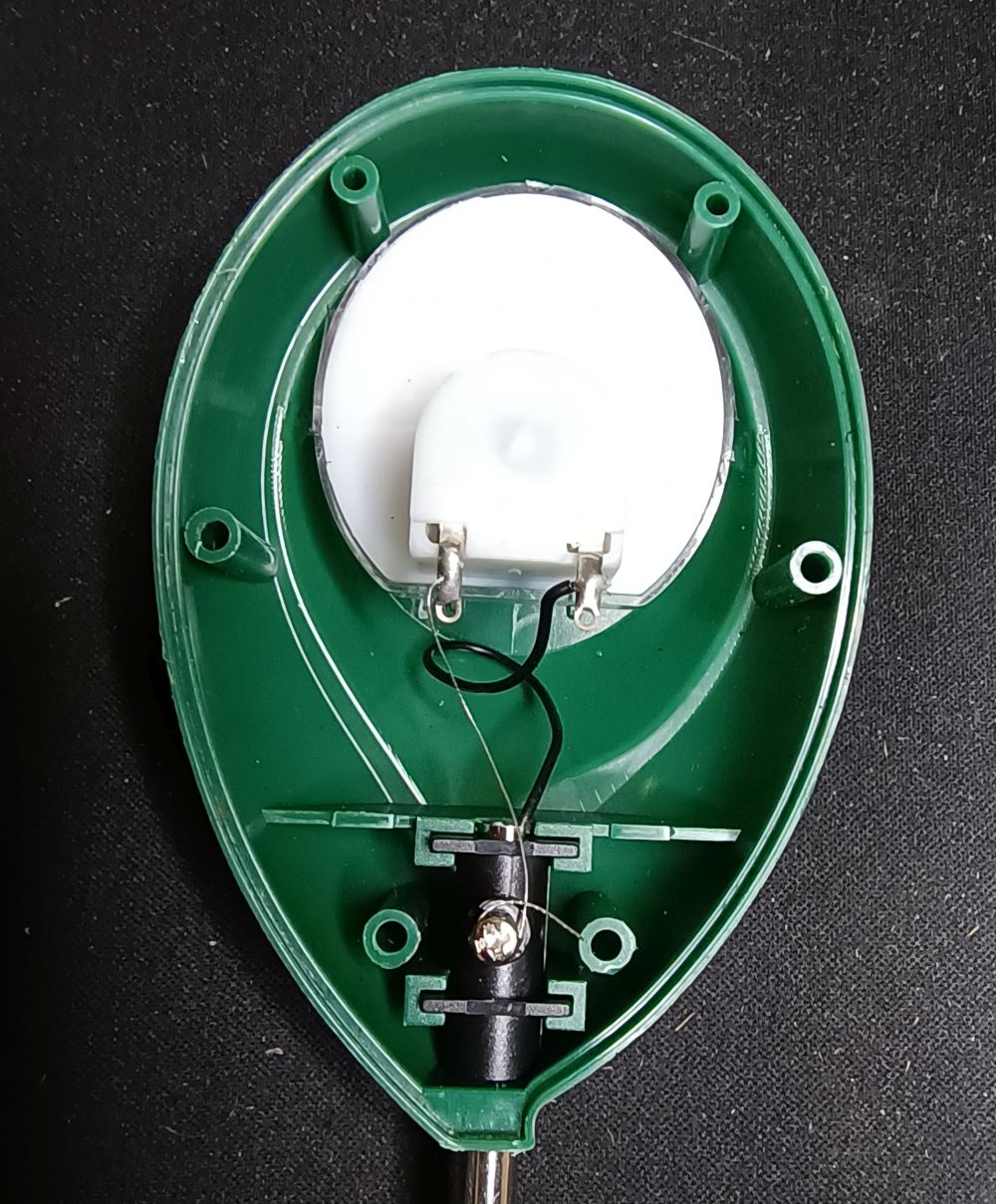
After opening it up and doing some research I found this type of meter works on the principle of a galvanic cell. The probe is made of two dissimilar metals and these are connected to a small meter. When the probes are placed in the soil, the moisture acts as an electrolyte sending a small amount of power to the meter.
These meters don’t have a great reputation. There are a lot of variables that affect the reading. Placing the probe into our rainwater gives a ‘dry’ reading, as the water does not contain any electrolytes. However, I have it and it seams to be useful for doing comparisons. There is still one big problem. Here it is illustrated by ChatGPT.
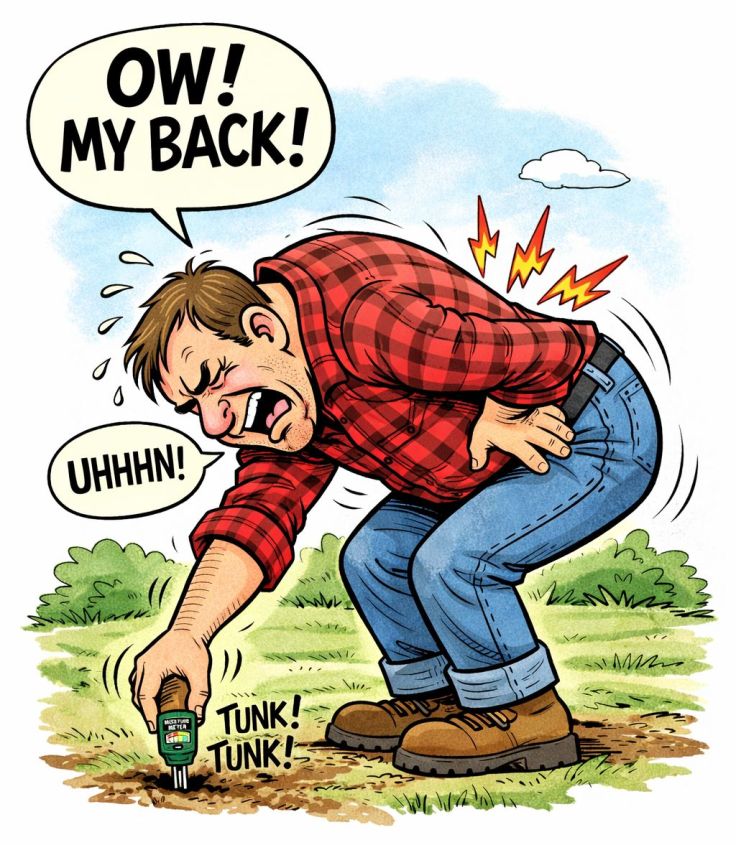
That’s right, constantly bending over to take readings literally becomes a pain.
I’ve been thinking about what I could use to extend the probe. Last week at our local tip shop I saw part of an old fishing pole. I bought a couple of things, so I don’t know the exact price, but it was probably somewhere between 50 cents and a dollar.

It’s a Devil. I’m still not sure whether that’s reassuring or concerning.
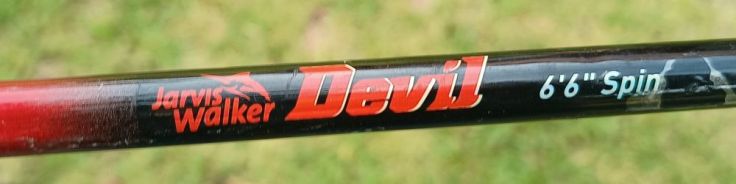
The rod is hollow, which allowed some old speaker cable to pass through it. I tested the probe with the longer wires to the probe and it seems like it doesn’t affect the reading.
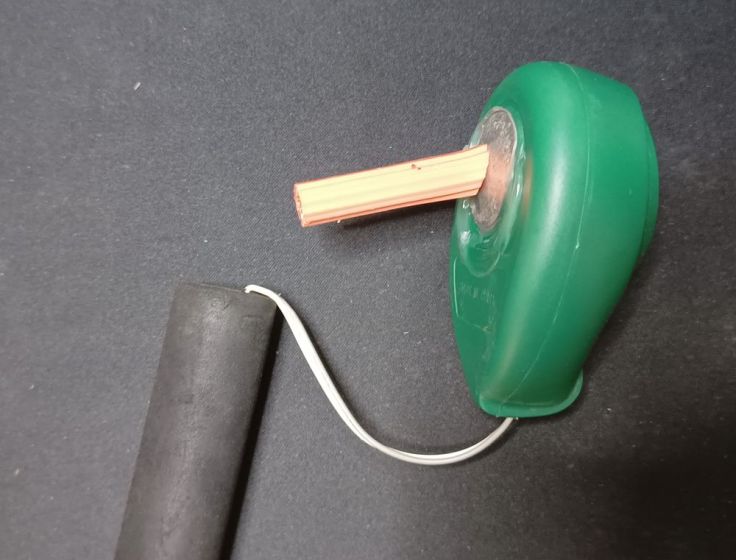
The most appropriate thing I had to fit the probe was a plastic expansion wall plug. These are used for screwing things to concrete. I had to increase the inner hole a bit to get the probe to fit, but it ended up a good tight fit.
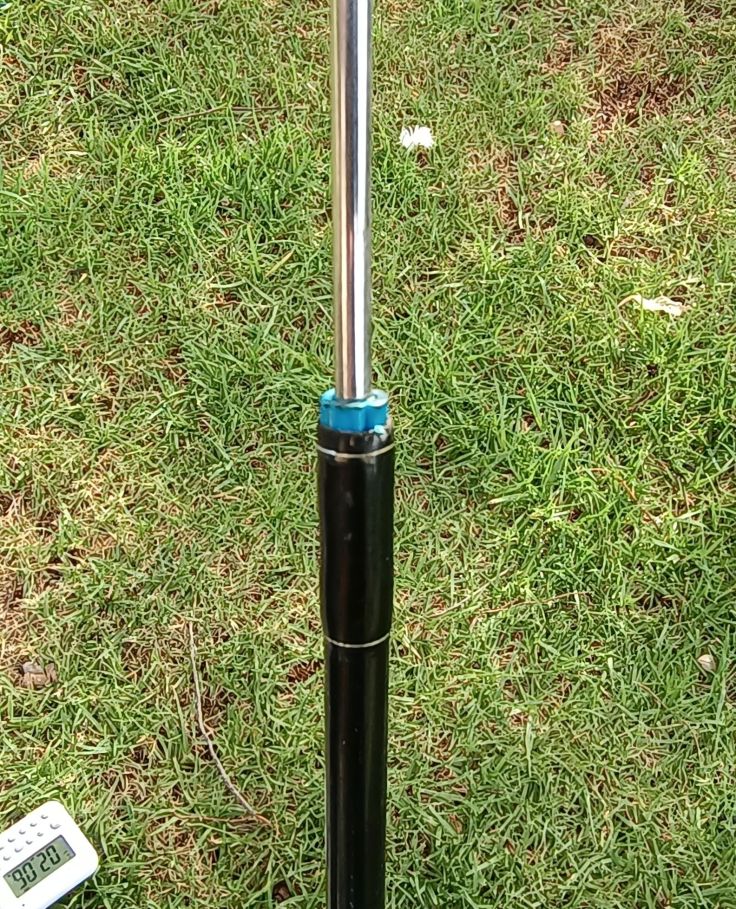
I used a larger wall plug, a screw, a washer, and some hot glue to attach the meter end to the fishing rod.
The result is a very light easy to use probe.

No bending and no glasses required.
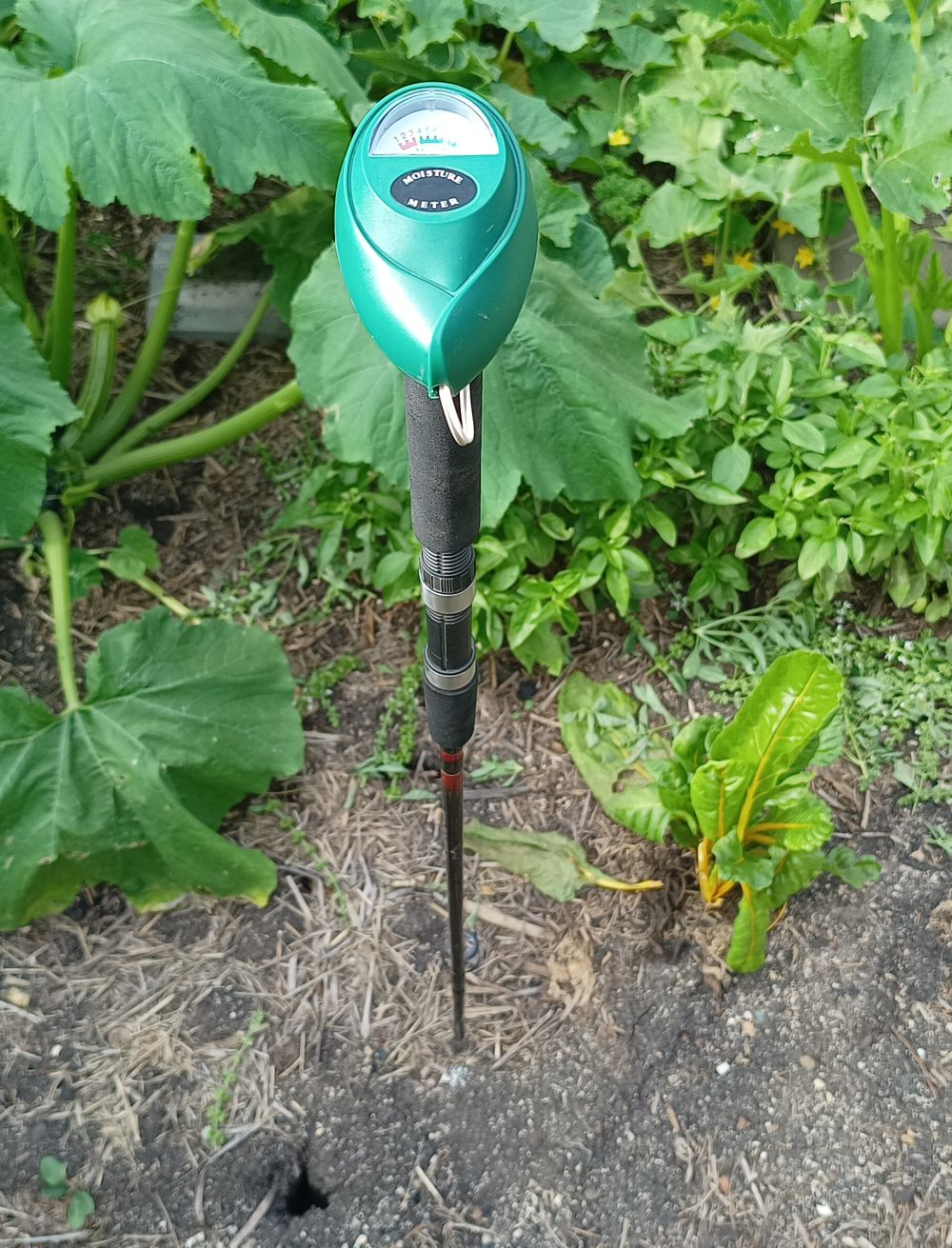


Greta idea.
My garden beds are ‘no-dig, no-bend’ – 800 mm high sides.
I’d love to have several permanent soil moisture probes in our Food Forest, but from what I’ve seen of those metal probe types, the continuous current flow promotes corrosion and failure.
I do have a different style that suits our Davis Weather Station, but the ‘repeater’ is outrageously expensive – the probe came with an earlier generation of (now incompatible) repeater.
On a side note – It’s weird how ‘clean’ rainwater can be.
We brought our Rocket Giotto coffee machine with us to our current location, which has an above ground steel tank (I expect it has a liner).
The previous property had an in-ground concrete rainwater tank and the coffee machine ‘always worked’.
Soon after our move, the machine started acting like there was no water in the machine’s reservoir at the back – despite it being full.
We took the machine to a coffee machine repairman in town, and it performed perfectly.
Brought it home – same problem. Did this rotation several time$$$$$.
Cutting a long story short – our rain water had insufficient conductivity, for the water-level circuitry to work.
Whereas, the town water was full of ions (and chlorine etc etc).
Now we add a pinch of Bicarb Soda once a week – problem solved.
LikeLike
Hi, Thanks for the feedback. I’ve heard that that at least some of the permanent moisture probes corrode. The ground moisture can vary so much here even in places that are only a metre or two apart, so it’s nice to be able to do a quick measurement anywhere.
The Davis weather stations look really nice. I decided to try and make my own, but if I included the time spent on it, I would have been better off buying one, but it has been a fun project. I hope to one day get the wind speed to give an accurate reading 🙂
There certainly is a big difference with tank water. Electric jugs, taps, and hot water systems usually last much longer and don’t get a build up of scale, but I had not heard that this could cause issues with coffee machines, but I can see how that could be a problem.
LikeLike