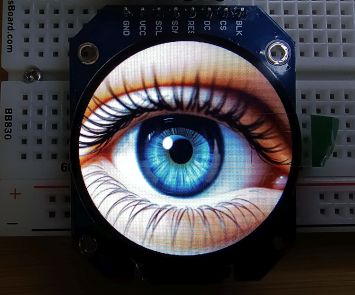
The first thing most of us do when learning Arduino try a blink sketch. In my quest to learn how to use cheap LCDs, I thought I’d do the same. In this case a simple animation blinking an eye. The plan was to make it display a couple of images; a closeup of an eye... Continue Reading →
Replacing a Rotary Encoder with a Magnetic Sensor and Potentiometer
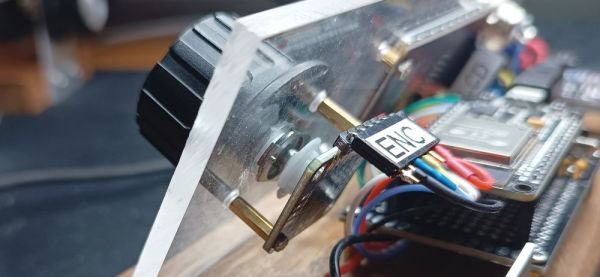
I've been thinking if there is an easy way to make a simple and cheap control knob to replace those cheap quadrature rotary encoders in Arduino projects without the need to change the Arduino code or at least very minimal changes. This would only work if the angle sensor could produce a quadrature output like... Continue Reading →
Converting a Potentiometer For Use With a Magnetic Rotary Encoder
I've been experimenting with angle sensor modules to use them as a replacement for those cheap rotary encoders. I like those cheap rotary encoders, but I'm looking for something better where the knob turns smoothly and it doesn't wear out. The cheap encoders wear fairly quickly and then contact bounce can become a problem. Also,... Continue Reading →
Hot and Bothered: DHT22 Temperature Sensor Issues
When I was contemplating building a weather station, the part that I thought would be the most straightforward was measuring temperature. As reality often doesn't match expectations, this has not been the case. I am using a couple of DHT22 temperature and humidity sensors. One for indoor and another for outdoors. I found this Random... Continue Reading →
Building a Tuning Wheel For PC SDR Radio Using an Angle Sensor
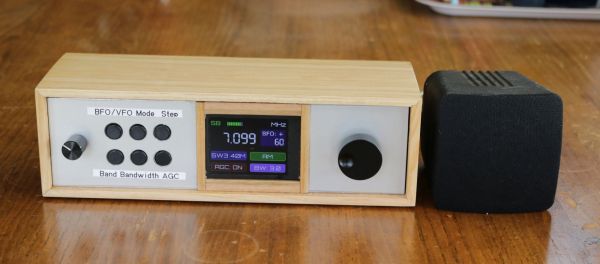
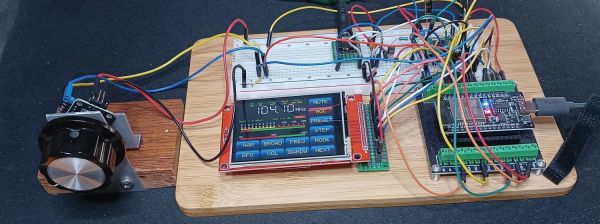
I have a soft spot for rotary encoders. They are so simple, yet work so well as an interface. I have mostly used the cheap mechanical quadrature rotary encoders that are sold on modules. However, there are a couple of projects that I'm interested in where these are not ideal. The first is the tuning... Continue Reading →
Ben Franklin and DIY Lightning Detection using a AS3935 Lightning Sensor
I've had an interest in detecting lightning for many years. I remember reading an article about Benjamin Franklins lightning experiments back in the 80's or early 90's. I thought the article was in an issue of Electronics Australia, but I have not been able to locate it. Ben Franklin is fairly well known for flying... Continue Reading →
Inside a Cheap Aluminium Anemometer
Choosing an Anemometer I've been considering what to use for an anemometer for my weather station. I was thinking of making my own, but a significant downside would be calibrating it. I checked what was available on AliExpress. Many are plastic and I don't want a plastic one and I don't want to have to... Continue Reading →
Building a Digital Wind Vane with a Bicycle Hub and Angle Sensor
Whenever someone pointed out to a work colleague that there was an easier way to do what he was attempting, he’d look confused and then reply, “Well, anyone can do it the easy way.” I seem to find myself avoiding the usual easier way with projects, just to try do it differently. That's how I... Continue Reading →
Rebuilding a rain gauge using ESP32 with live updates
I've been working on building a weather station over the last few months and while I haven't completed all the sensors, I have a few done including recently a rain gauge. The receiver is based around the "Random Nerd Tutorials ESP-NOW Web Server Sensor Dashboard" in which the data is displayed on a web page.... Continue Reading →
Customizing the Random Nerd Tutorials ESP-NOW Web Server Sensor Dashboard
I've wanted to build a weather station for a long time, probably for at least 30 years. Droughts are common here, and we rely on rain for all our household water. Our house is also quite exposed to strong winds. At one point a neighbour a couple of kilometers away had their roof blown off... Continue Reading →