I became aware of AI generated music a few months ago and began looking for examples. I was curious what it was like to use. This week I paid for a one month subscription to the AI music generator Suno to learn more. I'm not going to give my views on AI generated music. At... Continue Reading →
I Searched an Idea and Google’s AI Quoted My Blog
A few days ago I had the bright idea of using a magnetic angle sensor with an anemometer. I’ve been using a Hall effect sensor, which works fairly well, but I figured if I used an angle sensor I could take readings over a fixed time and use the number of degrees of rotation to... Continue Reading →
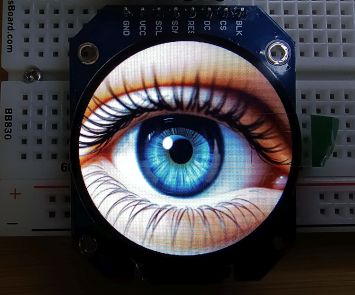
Animating a Blinking Eye on an Arduino-Powered LCD Display
The first thing most of us do when learning Arduino try a blink sketch. In my quest to learn how to use cheap LCDs, I thought I’d do the same. In this case a simple animation blinking an eye. The plan was to make it display a couple of images; a closeup of an eye... Continue Reading →
I Asked Claude for Info, and It Built a Standalone Tool
I’ve been learning to use LCD displays with Arduino via the LovyanGFX library. What I wanted was a simple image converter, something that could turn a picture into a data array I could paste into my Arduino sketch and display on the screen. A standalone tool is born By Googling, I found an online one... Continue Reading →
LovyanGFX Display Config Code: ILI9341, GC9A01 and ST7789 Displays
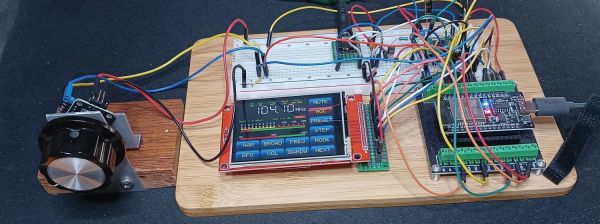
I've been building up a small collection of LCD screens for use with Arduino projects. I've uploaded a few example sketches mostly using Bodmer's TFT_eSPI library. I found it a little challenging to set the display configuration in the library, but otherwise it worked well. There seems to be some concern that the library is... Continue Reading →
Replacing a Rotary Encoder with a Magnetic Sensor and Potentiometer
I've been thinking if there is an easy way to make a simple and cheap control knob to replace those cheap quadrature rotary encoders in Arduino projects without the need to change the Arduino code or at least very minimal changes. This would only work if the angle sensor could produce a quadrature output like... Continue Reading →
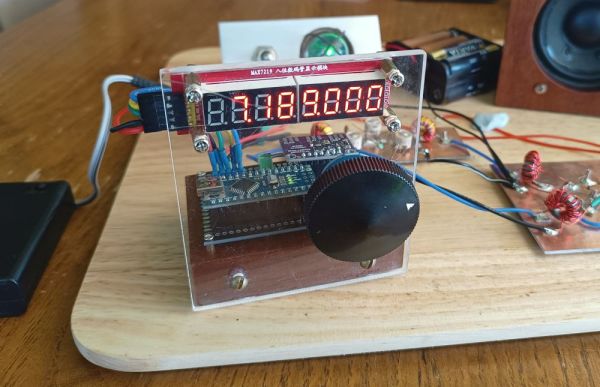
Me and ChatGPT build a Simple Si5351 VFO for the 40MHz Direct Conversion receiver
Ever since I started tinkering with Arduinos I’ve wanted to build a shortwave receiver using a Si5351 oscillator to tune the frequency. When I saw and built the Soldersmoke Direct Conversion receiver I immediately saw a chance to give it a try. While I've dabbled a lot with Arduinos, I have never used the Si5351.... Continue Reading →